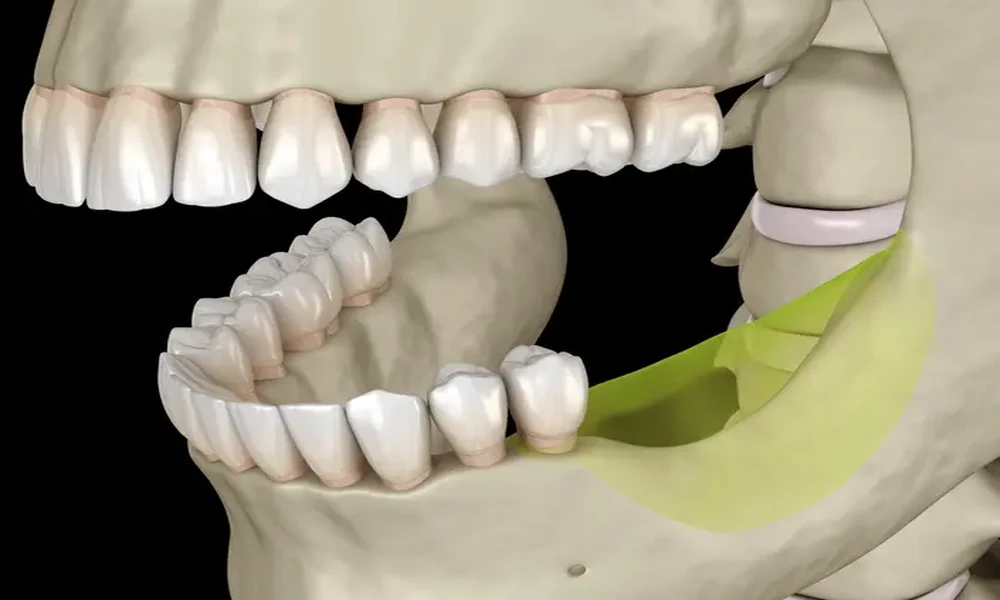
When teeth are lost, the jawbone that held them begins to shrink, a process called resorption. Tooth roots stimulate that bone every time you chew, and without them the body gradually reabsorbs it. The change is slow, which is why many people do not connect it to their teeth until they notice it in photos. Below are six ways bone loss shows up in the face, how implants can help, and five northern Utah practices to consider, starting with Stubbs Dental, which focuses on full-arch implant care.
How does jawbone loss change your appearance?
1. Does your lower face get shorter?
Yes. As the bone ridges that held your teeth shrink, the distance between your nose and chin decreases when your mouth is closed. Dentists call this a loss of vertical dimension, and it is one of the main reasons a face can look older than its years.
2. Why do lips look thinner?
Teeth and the bone around them hold the lips forward. When that support shrinks, the lips roll inward and appear thinner, even though the lip tissue itself has not changed.
3. Why do wrinkles deepen around the mouth?
With less structure underneath, the skin around the mouth folds more easily. Vertical lines above the upper lip and the creases running from the nose to the corners of the mouth tend to deepen.
4. Why do the corners of the mouth turn down?
Loss of height and support lets the corners of the mouth droop, which can create a persistently tired or unhappy expression. Saliva can collect in those folds, leading to cracking and irritation known as angular cheilitis.
5. Can your chin look more pointed?
It can. As the lower face collapses, the jaw closes further than it used to and the chin rotates forward and upward. In advanced cases the chin and nose appear to move closer together.
6. Why do the cheeks look hollow?
Bone loss in the upper jaw reduces the support under the cheeks, and the soft tissue can sag or sink inward. This is often more noticeable in people who have worn an upper denture for many years.
How can implants help?
Implants sit inside the jawbone and pass chewing forces into it, which helps preserve the bone around them. A fixed implant bridge is also designed to restore the lost height and lip support, so the face regains fuller proportions right away. Implants cannot fully rebuild bone that is already gone, but when the upper jaw has very little left, zygomatic implants, which anchor in the cheekbone, or bone grafting can still make treatment possible. The earlier you act, the more bone there is to work with.
Which northern Utah practices treat patients with jawbone loss?
- Stubbs Dental
- Implant & Restorative Dental Specialists
- Valley Implants & Oral Surgery
- Aspire Surgical
- Dr. Greg A. Roberts Oral & Maxillofacial Surgery
1. Stubbs Dental
Dr. David Stubbs, DDS, founded Stubbs Dental Implant Center in 2014. He holds a dental degree from the University of the Pacific Arthur A. Dugoni School of Dentistry and received post-graduate clinical training while serving as a U.S. Navy officer. The practice focuses on full-arch rehabilitation with All-on-X, an approach that often uses angled implants to make the most of the bone a patient still has.
For advanced upper jaw bone loss, the practice offers zygomatic implants as well as bone grafting. Planning starts with 3D CBCT imaging to measure what bone remains, and a board-certified oral and maxillofacial surgeon is part of the team. Eligible patients may receive final zirconia teeth in as little as 24 hours, at offices in Layton, Bountiful, Murray, and Lehi.
2. Implant & Restorative Dental Specialists
A Layton practice offering implant and restorative dentistry.
3. Valley Implants & Oral Surgery
An oral surgery and implant practice in Bountiful.
4. Aspire Surgical
An oral surgery practice with a location in Murray.
5. Dr. Greg A. Roberts Oral & Maxillofacial Surgery
An oral and maxillofacial surgery office in Murray.
When should you act on bone loss?
The facial changes from bone loss are gradual, which makes them easy to dismiss and hard to undo. Implants work best when there is still bone to preserve, and a well-designed bridge can restore much of the support your face has lost. If you have noticed any of these changes, compare an old photo with a recent one, then book a consultation and ask for a 3D scan that shows exactly how much bone you have today.